Friday, October 26, 2012

Bald Eagle perching on Shore Pine

Gerry observed and photographed yet another raptor in the bog:
 We had another successful work party this past Saturday with 15 volunteers in attendance. We collected mosses from the forest and planted a large section to the east of the platform.
    We collected more moss during the week in hopes that the weather will cooperate for another week and we will have time to plant remaining areas.
    While I was in the bog this past Sunday I look up as there was a number of crows making a lot of noise.This is a usual sign an intruder is in their area and sure enough the Bald Eagle  had landed some 50-60 ft. from where I was standing. He then proceeded to move to the dead shore pine. 
    The eastern Blue Jay that all the birders we looking for didn't show up in the bog but our Bald Eagle paid us a visit. Enjoy!
    See you all on Saturday.
    Gerry

Bald Eagle in Pinus contorta


Thursday, October 18, 2012

Looks Like Frog Pelt Lichen

Last Saturdays work party of 8 used up all the sphagnum mosses we had collected from the forest. It was used to plant two fairly big areas of the bog that we had been prepping for some time. We planted it just in time as the subsequent rains flooded the area. This Saturday we will have to look for areas dry enough to work. I thought I would share with the group some of the pictures I have taken of plants, other than sphagnum mosses, that also grow in the bog. Attached are pictures of a Lichen called Frog Pelt that is presently growing in the bog. Pojar states that it comes in 3 different colors: olive green, milky blue and dark slate blue. It has brownish, tooth like fruiting bodies (#9578) on raised lobes. The lower surface is whitish with long slender holdfasts called rhizines (# 7325). This lichen is located on a covered stump close to the "sphagnum mosses" sign just in front of the bench on the south side of the bog.  -- Gerry


Friday, September 14, 2012

Barred owl watches over our work party


"...As you can see from the attached photos, we had a wise old owl watching our every move. It was perched in a hemlock tree just at the 21st Ave. entrance. In the first photo he seems to be giving us " the sign of approval for a job well done." 
    We will continue with  the weeding, removal of the polytrichum and lowering of the bog surface in preparation for planting" 
--Gerry


Friday, September 7, 2012

Where the Wild Things Are Teacher Pro-D, Oct 19, 2012


that very night in Max's room a forest grew, and grew, until the ceiling hung with vines, and the walls became the world around...", 
- Maurice Sendak, Where the Wild Things Are.
Bog Buddy program, 2011. photo credit: Marian De Geer,
Biology 11 students teach elementary students in Camosun bog: photo credit: Marian De Geer

When: October 19, 2012  9:30 - 12:30 pm
Who can register:    youth leaders, urbanists, teachers, informal educators,  student teachers.  Register by contacting  Susan at codesignyouthmanual@gmail.com
(If you are a teacher, please let us know if you are secondary or elementary).
Cost: free
Presenters:  VSB teachers, The Camosun Bog Restoration Group, Metro Vancouver Regional Parks interpreters, and Co-Design Group
Dress code, what to bring:  
This is an outdoor program happening rain or shine. Be prepared for rain. Bring your favourite tea mug. 

Join the Crazy Boggers, Metro Vancouver Regional Park interpreters and VSB teachers for an active and informative Pro-D walking through an enchanting urban bog! Learn the fascinating story of this ancient ecosystem and methods for interpreting the bog for students of all ages. Taste Labrador Tea, touch a carnivorous sundew and Jump on a bog trampoline! Walk away with lesson strategies, classroom resources and the ability to identify at least five bog species and five invasive species, guaranteed!

Purpose of this workshop:
  • To give educators the tools to bring their classrooms and small groups to the bog with confidence
  • To familiarize educators with the bog narrative, bog ecology and share connections to the elementary and secondary curriculum.
  • To encourage educators to visit our bog. Camosun bog is the most transit - accessible bog in Vancouver and we encourage everyone to experience this treasure in the city
Our presenters have experience interpreting the bog for elementary students and secondary students up to senior secondary. Furthermore, the metro vancouver regional parks interpreters are well versed in presenting the bog in an informal context. The bog is a great outdoor classroom for the following topics:

plant anatomy
ecological succession
bog ecology
bryophytes
plant competition
urban geography
local history of our city
and it is a wonderful location for inspiring students to create art, poetry, short stories.


Saturday, June 16, 2012

The Life Cycle of a Sphagnum Moss

When one works with Sphagnum moss, its good to know how it grows and reproduces. Mosses have different life cycles than plants or animals, that most people are completely unaware of. They have an "alternation of generations" which means the haploid (N) and diploid (2N) stages of life are multicellular and long lived. The 'ploidy' relates to how many sets of chromosomes you have. If you are 2N, you have one set of chromosomes from your mother, and one set of chromosomes from your father. If you are N, you only contain one set of chromosomes, either from your mother or from your father. Lets start the life cycle with a spore.

Monday, April 2, 2012

sundews are back!

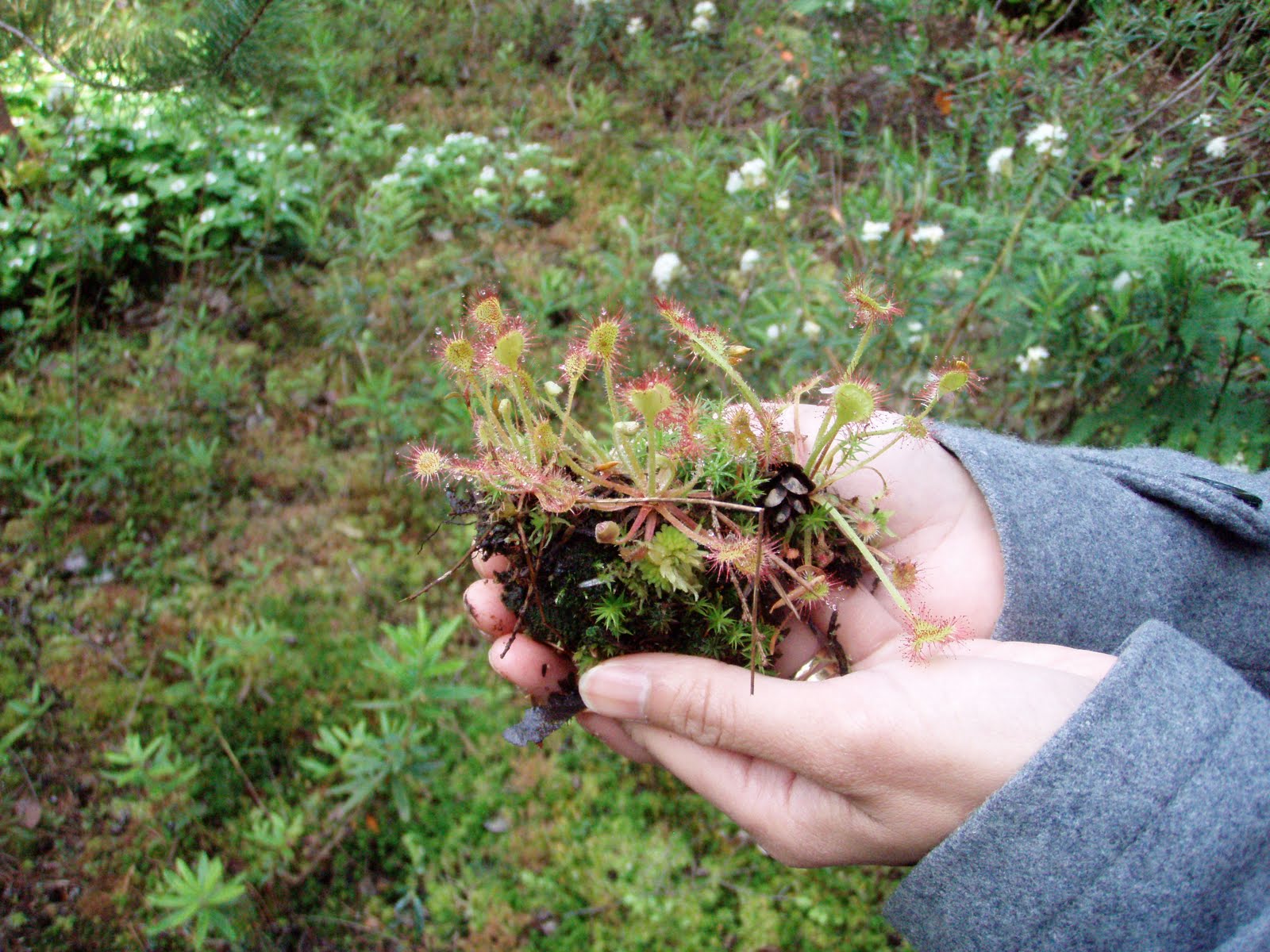
Drosera rotundifolia unfurls its sticky tendrils to get ready for this year's mosquito season.  Does it look hungry?  It's only the diameter of a Canadian Loonie (one dollar coin) at the moment.  Eventually it will get to the size below:  (picture below from 2010)  Kids who visit the bog love to observe this carnivore in action.

Saturday, March 31, 2012

March 24 Planting Party at Stanley Park Bog

We were very lucky to have a bright sunny day when we assisted the Stanley Park Ecology Society in planting the large area that had been cleared and levelled. We were able to complete the entire area and in the process used no less than 24 baskets of sphagnum. We were delighted to have Loretta Woodcock join us as funding for this project was due to her efforts with the Vancouver Parks Board. (thanks to Susan and Loretta for the photos)

Loretta Woodcock with Laurence
.